Melody of Life

The show that is full of life

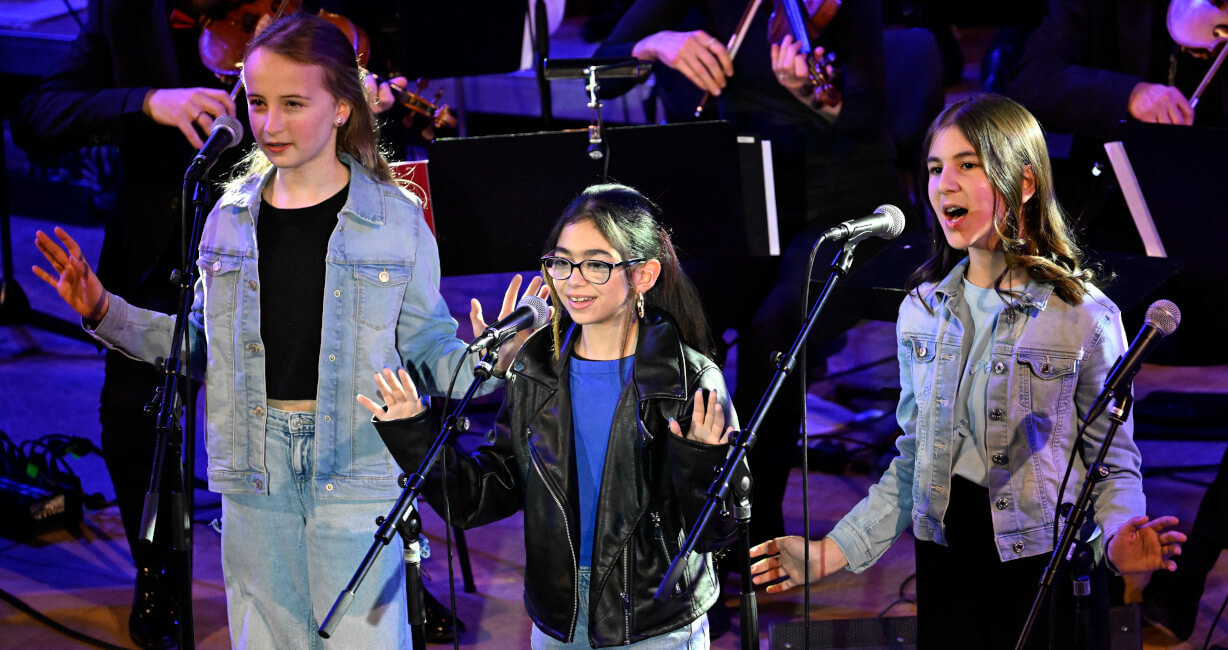
The ›Melody of Life‹ comes directly from the heart of the Osterholz-Tenever district. How does it sound? Different every time! Yet the basic formula for this unique format from The Deutsche Kammer­philharmonie Bremen’s Future Lab remains the same; schoolchildren who turn their lives and feelings into songs and take them to the stage where they are instrumentally accompanied by a world-class orchestra.

The show’s figurehead is Mark Scheibe, a symphonic composer with a passion for both revue and high culture, who conceived the ›Melody of Life‹ in 2007 and has played a key role in shaping every production since.[AP1]  Together with the young performers, he transcribes their stories into poetry and music, which is then brought to life on stage with the dramatics of the full orchestra. On the night of the show, he assumes the role of charming compère. Also present to support the children and young people are the school’s dedicated teachers, and an audience that is clearly drawn in by the youngsters’ performances. Melody of Life is a stage show that is certain to get under your skin.

Next concert

12. & 13. November 2026, 7.30 p.m.

concert calendar

The sound of OTe

Bitter here, sweet there, but always captivating

Hopes, dreams, fears and longings – these are just some of the topics which are given musical expression and which allow audiences an insight into the inner world of today’s younger generation; normal everyday life which may be reflected just as easily in a song praising nature as in a song portraying worries about the future or love. The truth is that ›Melody of Life‹ doesn`t always sound completely perfect, but it is often touching and always genuine.

The musical spectrum of the show series ›Melody of Life‹ is as varied as the district which produced it. Whether it be solo or group performances, whether rap, classical or chanson, anything is possible! For the 27 editions of the show so far, nearly 500 songs, anthems, ballads, grotesques, collages and instrumental pieces have been composed – all scored for the orchestra – which the pupils have filled with their many stories. As the show’s composer and musical director, Mark Scheibe has worked on the songs and lyrics with some 2,000 young people since 2007.

The stars of the show

From the classroom to the stage

Several weeks before the show, artistic director Mark Scheibe, who alternates between living in a Berlin hotel or on a houseboat, travels to the socially disadvantaged Bremen neighbourhood. Here, the young people open up to the symphonic musician and composer, share what’s on their minds, what gets on their nerves or piques their curiosity, and describe what upsets them or brings them joy. Showing a keen sensitivity for the complex emotional world of each pupil, Mark Scheibe listens and begins to interpret their narratives in first sounds. Together, musical ideas are developed, texts and songs fine-tuned to maturity until they are ready for the stage.

The young people are supported and guided on an equal footing by their teachers as well as by members of The Deutsche Kammer­philharmonie Bremen, both in rehearsals and live on-stage. Mark Scheibe also tailors the music specifically to the orchestra, bringing both groove and depth to ensure a rich fullness of sound. When it’s »Showtime«, the young people take centre stage – some for the very first time – to present their songs, excelling themselves in the process. Together, they all bring unique music to the stage that just a few weeks earlier didn’t exist: the Melody of Life.

Unique? Not quite, because inspired by the success of the Bremen pilot project, a school on the outskirts of Tunis has established its very own ›Future Lab Tunisia‹ in collaboration with the Tunisian National Orchestra. The Kamel Lazaar Foundation is acting as partner to the project, and the Tunisian Future Lab spin-off is also supported by the Federal Foreign Office.

The sound of OTe

Bitter here, sweet there, but always captivating

Hopes, dreams, fears and longings – these are just some of the topics which are given musical expression and which allow audiences an insight into the inner world of today’s younger generation; normal everyday life which may be reflected just as easily in a song praising nature as in a song portraying worries about the future or love. The truth is that ›Melody of Life‹ doesn`t always sound completely perfect, but it is often touching and always genuine.

The musical spectrum of the show series ›Melody of Life‹ is as varied as the district which produced it. Whether it be solo or group performances, whether rap, classical or chanson, anything is possible! For the 27 editions of the show so far, nearly 500 songs, anthems, ballads, grotesques, collages and instrumental pieces have been composed – all scored for the orchestra – which the pupils have filled with their many stories. As the show’s composer and musical director, Mark Scheibe has worked on the songs and lyrics with some 2,000 young people since 2007.

›Melody of Life‹ november 2024

Melody of Life – Digital

Much feeling from afar

The digital film screening of the ›Melody of Life: Composition‹. Artistic Director, Mark Scheibe and Project Director Mona Heiler guide you through the virtual concert.

Typically, the ›Melody of Life‹ with singing takes place together with the Deutsche Kammer­philharmonie Bremen in Osterholz-Tenever, in front of a large audience. This was not possible in the spring of 2021. However, with the Future Lab’s usual creative energy and the innovative spirit and entrepreneurship of the Deutsche Kammer­philharmonie Bremen, the ›Melody of Life: Composition‹ has been developed by Mark Scheibe with, instead of singing, compositions. The pupils of the Bremen Ost Comprehensive School shared their stories with each other and together with Mark Scheibe in intensive symphonic workshops, they developed these unique compositions which, as is customary, are shaped by the experiences of these young talented pupils.

What makes the film screening particularly exciting is a look behind the scenes. The creation process behind all these compositions has been accompanied by the camera to give audiences some of the background that would otherwise be denied them.

go to the Video