It was probably in the summer of 1791, while Haydn was spending five weeks outside London at the country home of his friend and patron, Nathaniel Brassey, that he did preliminary work on this B flat symphony, around the same time that he completed the ›Surprise‹ Symphony. In a famous letter to his Viennese friend Maria Anna von Genzinger, the composer speaks of this period in glowing terms:
of the ›loveliest scenery‹ and living ›as if I were in a monastery‹, and how ›in the early mornings I walk in the woods, alone, with my English grammar …‹4
However, it seems it was not until the following January or February that the piece was actually finished, and it was first performed on 2 March of that year. By that time, Haydn had had the most terrible news. Right at the very end of 1791 or more likely at the beginning of 1792, he made a laconic but shocking entry in his private notebooks: Mozard [sic] died on 5th Dec. 1791. 5
From the Romantics onward, there have been those who have wanted to hear in this deeply felt symphony a memorial by Haydn to his young friend whom he loved and admired so much. And perhaps it is true he was reflecting Mozart in this music; or perhaps it isn’t. Whatever the unknowable facts, it is moving for the rest of us, more than two centuries later, to know it was while working on this music that the composer learned what had happened in faraway Vienna.
There are other good reasons why this music sounds intensely personal and touching that do not need romantic explanations. One of them lies in the scoring. According to scholars, it was rare at this period that composers used trumpets and drums in the key of B flat, and this symphony marks the first time Haydn used such instruments. One of the reasons composers had tended to avoid this key is because, with the trumpets of the period, the effect – for acoustic reasons – was darker, more serious and mysterious than the usual bright sound of trumpets in, say, D major. But in this symphony, darkness and mystery, and a kind of inner glow, are exactly what the composer wanted.
The transformation of orchestral sound in this symphony does not stop with trumpets and drums. The whole score abounds in subtle effects: marvellously interwoven mixtures of woodwind and strings, for example; delicate solos for the first oboe (especially in the opening movement); passages where the entire section of cellos or first violins set out on their own, almost like a group of concerto soloists; a terrific violin solo in the last movement which was evidently a tribute to – and perhaps a way of teasing – Haydn’s friend, the director of these concerts and the impresario who had brought him to England, Johann Peter Salomon. And finally, only a few moments before the end, and perhaps the oddest effect in all the twelve London Symphonies, a few bars of brilliant arpeggios, like tinkling bells, for the upper register of the fortepiano, which Haydn wrote for himself to play, popping up like a jack-in-the-box almost in the very last bars.
4 Letter to Frau M A von Genzinger, 17 September 1791. Original in German.
5 Original in German.

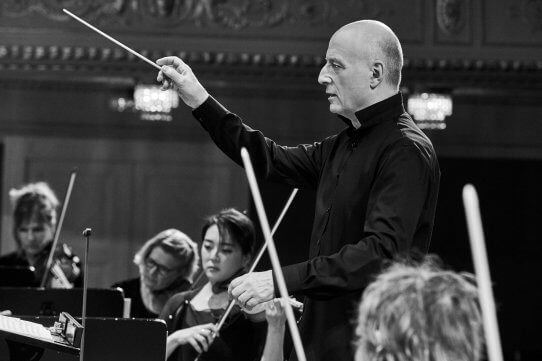 © Foto: Julia Baier
 © Foto: Julia Baier
 © Foto: Julia Baier
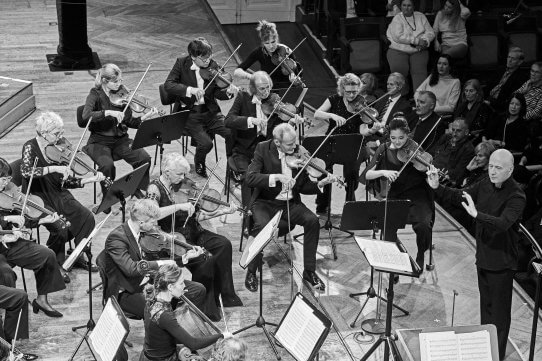 © Foto: Julia Baier
 © Foto: Julia Baier
 © Foto: Julia Baier