It was the violinist, composer and entrepreneur Johann Peter Salomon who was most responsible for persuading Haydn to make his two trips to London. Towards the end of 1790 he raised the money and travelled to Vienna to invite the great composer to accompany him to England, and it was he again who persuaded him to come back for his second visit in 1794.
Salomon’s concerts took place in the Hanover Square Concert Rooms, not far from the London intersection nowadays called Oxford Circus, a venue originally established a few years earlier by the German composers Johann Christian Bach and Carl Friedrich Abel. But in the winter of 1794 to 1795, the ongoing effects of war in Europe and economic disarray at home meant that Salomon was obliged to close his series and combine with a rival company occupying a newly-built concert hall attached to the King’s Theatre, Haymarket, a few streets south and east of Hanover Square. As the King’s Theatre was mostly known for opera, these new concerts were called ›Concerts at the Opera‹ and it was in the theatre’s ›New Room‹ that Haydn gave all his last London concerts between January and May 1795, including the first performances of his last three symphonies.
His penultimate, No. 103 › Drum Roll‹, was first performed in the New Room on 2nd March 1795, almost exactly a year to the day since the first performance of the 101st Symphony in nearby Hanover Square. And as with nearly all Haydn’s performances in London, it was a huge success: »Another new Overture, by the fertile and enchanting Haydn, was performed; which, as usual, had continual strokes of genius, both in air and harmony. The Introduction excited the deepest attention, the Allegro charmed, the Andante was encored, the Minuets, especially the Trio, were playful and sweet, and the last movement was equal, if not superior to the preceding.«
On the face of it, this might not seem the most revealing review. But the critic was not wrong in observing that »the Introduction excited the deepest attention«. In all of Haydn’s later symphonies, it is the slow introductions at the beginning of the first movements (only one of the London symphonies does without such an introduction) which, like the apparently casual opening lines of a Shakespeare play, most powerfully establish the drama and musical content of the whole work.

 © Foto: Julia Baier
 © Foto: Julia Baier
 © Foto: Julia Baier
 © Foto: Julia Baier
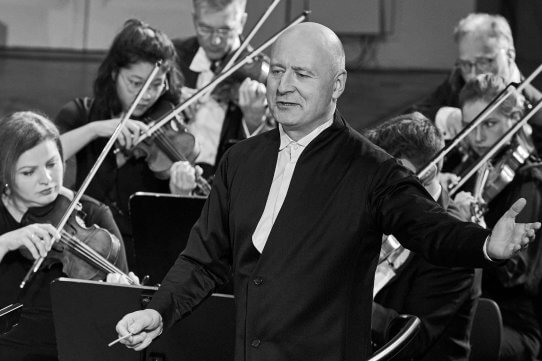 © Foto: Julia Baier
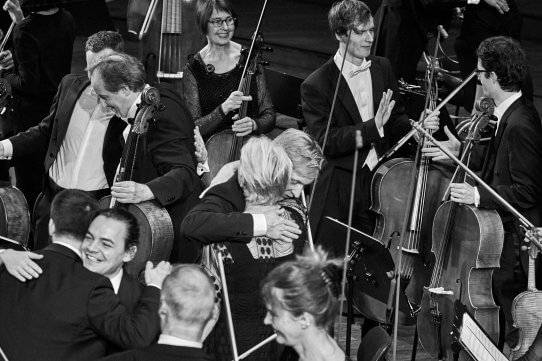 © Foto: Julia Baier