• Sun 05.10.
  • 8.00 p.m.
  • Bremen
    ·Sendesaal

Works by Beethoven, Strauss and Brahms

4th Highlight Subscription Concert

Programme

    • Ludwig van Beethoven (1770–1827)
    • Overture ›The Consecration Of The House‹ in C major, op. 124
    • Richard Strauss (1864–1949)
    • Duett-Concertino for Clarinet and Bassoon
    • Johannes Brahms (1833–1897)
    • Serenade No. 1 in D major op. 11

Conductor

Paavo Järvi

Estonian conductor and Grammy Award winner Paavo Järvi has been Artistic Director of the Deutsche Kammer­philharmonie Bremen since 2004. One of the many highlights of this collaboration has been the acclaimed, globally celebrated performances of the Beethoven cycle, for which Järvi received numerous awards including the ›Echo Klassik Conductor of the Year‹ award and the prestigious annual ›German Record Critics‹’ award. Their Beethoven project was followed by an intensive exploration of the symphonic works of Schumann and Brahms; both cycles also received numerous awards. Since autumn 2021, the focus has been on Joseph Haydn’s twelve London symphonies, and since 2024, an intensive exploration of Franz Schubert’s symphonies.

Paavo Järvi has been Music Director of the Tonhalle Orchestra Zurich since the start of the 2019/2020 season. He is also the founder and Artistic Director of the Estonian Festival Orchestra and the Pärnu Music Festival, which he established in 2011. He regularly appears as a guest conductor with major orchestras such as the Royal Concertgebouw Orchestra Amsterdam, the London Philharmonia Orchestra, the Berliner Philharmoniker, the Staatskapelle Dresden, the New York and Los Angeles Philharmonic Orchestras and the Chicago Symphony Orchestra. In 2015, he was named ›Artist of the Year‹ by both the British magazine Gramophone and the French magazine Diapason. This was followed in 2019 by the Opus Klassik award for ›Conductor of the Year‹. Other awards include a Grammy Award for his recording of Sibelius’ Cantatas with the Estonian National Symphony Orchestra and the title ›Commandeur de L’Ordre des Arts et des Lettres‹, awarded by the French Ministry of Culture. In 2015, Paavo Järvi also received the Sibelius Medal in recognition of his work in bringing this Finnish composer’s music to a wider audience, and in 2012 he received the Hindemith Prize for Art and Humanity. As a committed supporter of Estonian culture, Paavo Järvi was awarded the Order of the White Star by the President of Estonia in 2013.

Clarinet

Matthew Hunt

As one of the leading British clarinettists and most striking musicians, Matthew Hunt is known for the outstanding sound of his playing and for his ability to communicate with his audiences.

As soloist, Matthew has recently performed with conductors such as Trevor Pinnock, Clemens Schulte, Pekka Kuusisto, as well as with orchestras such as the Australian Chamber Orchestra Collective, the Concertgebouw Chamber Orchestra, the Estonian festival Orchestra and as guest performer with the Berlin Philharmonic in the Berlin Kammermusik Saal. He is a passionate chamber musician and his partners to date include Meta4-, Chiarascuro-, Pavel Haas, the Elias Quartet as well as Pekka Kuusisto, Alina Ibragimova, Thomas Adès, Nicholas Altstaedt, Steven Isserlis, Elisabeth Leonskaja, Alexander Lanquich and the jazz pianist Iiro Rantala. Matthew Hunt is also principal clarinet with the Deutsche Kammer­philharmonie Bremen.

For the coming season, festival performances are planned in Norway, Switzerland, Belgium and America, plus further performances of Max Bruch’s concerto with Maté Szücs in the Berlin Philharmonie, as well as joint appearances with the much praised chamber ensemble ›Orsino‹.

Matthew Hunt’s recording of Mozart’s Clarinet Quintet, which has been greatly praised by the critics, has been hailed by BBC Music Magazine as a »seminal recording of this frequently recorded work«.

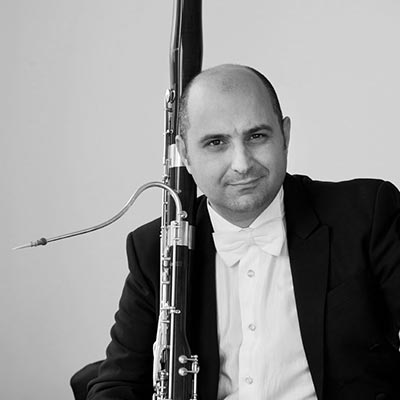
Bassoon

Higinio Arrué

Higinio Arrué has played solo bassoon with The Deutsche Kammer­philharmonie Bremen since 2000. Raised in Spain, he followed up his studies there at the University of the Arts Bremen under his predecessor David Tomás and at the Folkwang University of the Arts Essen under Prof. Gustavo Núñez. He was a member of the Spanish National Youth Orchestra and the European Union Youth Orchestra.

Higinio Arrué has made guest performances with the Orquesta Ciutat de Barcelona i Nacional de Catalunya, the NDR Sinfonieorchester Hamburg and the Royal Concertgebouw Orchestra Amsterdam.

As a chamber musician he plays with the woodwind ensemble ›Moonwinds‹ and of course the wind soloists of The Deutsche Kammer­philharmonie Bremen. He has worked on several occasions with the Daniel Hope Ensemble and has performed regularly with the Spanish Miró Ensemble.

Higinio Arrué is Professor of Bassoon at the Music Conservatorie ›Musikene‹ in San Sebastian. On CD he can be heard as a soloist in Richard Strauss’ ›Duet Concertino‹, accompanied by ›his‹ Kammerphil-harmonie under the baton of Paavo Järvi.

Conductor

Paavo Järvi

Estonian conductor and Grammy Award winner Paavo Järvi has been Artistic Director of the Deutsche Kammer­philharmonie Bremen since 2004. One of the many highlights of this collaboration has been the acclaimed, globally celebrated performances of the Beethoven cycle, for which Järvi received numerous awards including the ›Echo Klassik Conductor of the Year‹ award and the prestigious annual ›German Record Critics‹’ award. Their Beethoven project was followed by an intensive exploration of the symphonic works of Schumann and Brahms; both cycles also received numerous awards. Since autumn 2021, the focus has been on Joseph Haydn’s twelve London symphonies, and since 2024, an intensive exploration of Franz Schubert’s symphonies.

Paavo Järvi has been Music Director of the Tonhalle Orchestra Zurich since the start of the 2019/2020 season. He is also the founder and Artistic Director of the Estonian Festival Orchestra and the Pärnu Music Festival, which he established in 2011. He regularly appears as a guest conductor with major orchestras such as the Royal Concertgebouw Orchestra Amsterdam, the London Philharmonia Orchestra, the Berliner Philharmoniker, the Staatskapelle Dresden, the New York and Los Angeles Philharmonic Orchestras and the Chicago Symphony Orchestra. In 2015, he was named ›Artist of the Year‹ by both the British magazine Gramophone and the French magazine Diapason. This was followed in 2019 by the Opus Klassik award for ›Conductor of the Year‹. Other awards include a Grammy Award for his recording of Sibelius’ Cantatas with the Estonian National Symphony Orchestra and the title ›Commandeur de L’Ordre des Arts et des Lettres‹, awarded by the French Ministry of Culture. In 2015, Paavo Järvi also received the Sibelius Medal in recognition of his work in bringing this Finnish composer’s music to a wider audience, and in 2012 he received the Hindemith Prize for Art and Humanity. As a committed supporter of Estonian culture, Paavo Järvi was awarded the Order of the White Star by the President of Estonia in 2013.

Bassoon

Higinio Arrué

Higinio Arrué has played solo bassoon with The Deutsche Kammer­philharmonie Bremen since 2000. Raised in Spain, he followed up his studies there at the University of the Arts Bremen under his predecessor David Tomás and at the Folkwang University of the Arts Essen under Prof. Gustavo Núñez. He was a member of the Spanish National Youth Orchestra and the European Union Youth Orchestra.

Higinio Arrué has made guest performances with the Orquesta Ciutat de Barcelona i Nacional de Catalunya, the NDR Sinfonieorchester Hamburg and the Royal Concertgebouw Orchestra Amsterdam.

As a chamber musician he plays with the woodwind ensemble ›Moonwinds‹ and of course the wind soloists of The Deutsche Kammer­philharmonie Bremen. He has worked on several occasions with the Daniel Hope Ensemble and has performed regularly with the Spanish Miró Ensemble.

Higinio Arrué is Professor of Bassoon at the Music Conservatorie ›Musikene‹ in San Sebastian. On CD he can be heard as a soloist in Richard Strauss’ ›Duet Concertino‹, accompanied by ›his‹ Kammerphil-harmonie under the baton of Paavo Järvi.